

How Many Animals Killed For Research Exxon Valdez Oil Spill
| Exxon Valdez oil spill | |
|---|---|
 Three days after Exxon Valdez ran ashore | |
 | |
| Location | Prince William Sound, Alaska |
| Coordinates | 60°50′24″North 146°51′45″W / 60.8400°Due north 146.8625°Westward / 60.8400; -146.8625 Coordinates: 60°fifty′24″N 146°51′45″Due west / 60.8400°N 146.8625°W / 60.8400; -146.8625 |
| Engagement | March 24, 1989 (1989-03-24) |
| Cause | |
| Crusade | Grounding of the Exxon Valdez oil tanker |
| Operator | Exxon Shipping Company |
| Spill characteristics | |
| Volume | 10.8×10 |
| Shoreline impacted | i,300 mi (2,100 km) |
The Exxon Valdez oil spill occurred in Prince William Sound, Alaska, on March 24, 1989. Exxon Valdez, an oil supertanker endemic by Exxon Shipping Company bound for Long Beach, California struck Prince William Audio's Bligh Reef, i.5 mi (2.4 km) west of Tatitlek, Alaska at 12:04 a.m. and spilled 10.8 million The states gallons (257,000 bbl) (or 37,000 tonnes)[one] of rough oil over the next few days.[2]
The Exxon Valdez spill is the second largest in U.S. waters, after the 2010 Deepwater Horizon oil spill, in terms of book of oil released.[3] [four] Prince William Sound's remote location, accessible just by helicopter, airplane, or boat, fabricated authorities and manufacture response efforts difficult and made existing response plans especially hard to implement. The region is a habitat for salmon, sea otters, seals, and seabirds. The oil, extracted from the Prudhoe Bay Oil Field, somewhen affected 1,300 miles (2,100 km) of coastline, of which 200 miles (320 km) were heavily or moderately oiled.[2] [5] [6]
Spill [edit]
Exxon Valdez was conveying 53.1 one thousand thousand US gallons (i,260,000 bbl; 201,000 m3) of oil, of which approximately x.8 1000000 US gallons (260,000 bbl; 41,000 kiii) were spilled into the Prince William Sound.[ii] [3] [7] [8] [9]
The ship docked at the Valdez Marine Terminal[ten] at 11:30 p.m. on March 22, 1989. Loading of rough oil was completed late in the day on the 23rd. The tanker left the terminal at 9:12 p.m. March 23, 1989 (the deck log shows that information technology was clear of the dock at 9.21 p.m.), loaded with 53,094,510 gallons (i,264,155 barrels) of crude oil. Captain Joseph Hazelwood retired to his cabin at 9.25 p.m.. Harbor pilot William Murphy and Tertiary Mate Gregory Cousins were accompanied past a single tug for the passage through the Valdez Narrows – a journey of nearly vii miles. The airplane pilot left the bridge shortly after the vessel left the narrows, at eleven.24 p.g. At this point, the captain was chosen to the bridge. Cousins helped the airplane pilot disembark from the vessel, leaving the captain equally the only officeholder on the bridge. At 11.25 Exxon Valdez reported that the pilot had left. The third mate brash traffic command and decided to deviate from the predetermined traffic lane to avoid small icebergs; a mutual occurrence since the Columbia Glacier calved such icebergs nearby. The vessel was placed on a s course and prepare on autopilot. At 11.47 p.m. the vessel left the traffic lane's eastern boundary.
Third Mate Cousins had been on duty for six hours and was scheduled to be relieved by Second Mate Lloyd LeCain Jr. However, due to the long hours that the second mate had worked, Cousins was reluctant to wake him, and remained on duty. Cousins was the only officeholder on the span for about of the night, in violation of company policy. At around midnight on March 24 Cousins began to maneuver the vessel into the traffic lanes. At the same time, the lookout reported that the Bligh Reef light appeared far off the starboard bow at 45 degrees – this was problematic given that the lite should take been off the port side. Cousins ordered a course change equally the ship was in danger. Captain Hazelwood was phoned past Cousins, but before their chat could cease, the ship grounded. At 12.04 a.grand., accompanied by what the helmsman and Cousins described equally "a bumpy ride and "six very sharp jolts" respectively, the ship ran aground on Bligh Reef.
Carried by its own momentum, the send ended up perched on its heart on a pinnacle of rock. 8 out of 11 cargo holds were punctured. 5.eight million gallons of oil drained from the send within 3 hours and 15 minutes. 30 minutes afterward numerous attempts to dislodge the ship under her own ability, Captain Hazelwood radioed the Coast Guard informing them of the grounding. For more than 45 minutes after the grounding, the captain attempted to maneuver free of the reef despite existence informed by First Mate James Kunkel that the vessel was not structurally sound without the reef supporting it.[11]

During the first few days of the spill, heavy sheens of oil covered big areas of the surface of Prince William Sound.
Multiple factors have been identified as contributing to the incident:

Commencement 3 days later on the vessel grounded, a tempest pushed large quantities of fresh oil onto the rocky shores of many of the beaches in the Knight Island chain.[12] In this photograph, pooled black oil is shown stranded in the rocks
- Exxon Shipping Company failed to supervise the master (transport'southward captain) and provide a rested and sufficient crew for Exxon Valdez. The NTSB institute this practice was widespread throughout the industry, prompting a rubber recommendation to Exxon and to the manufacture.[13]
- The 3rd mate failed to properly maneuver the vessel, possibly due to fatigue or excessive workload.[thirteen]
- Exxon Aircraft Visitor failed to properly maintain the Raytheon Collision Avoidance Organisation (RAYCAS) radar, which, if functional, would take indicated to the third mate an impending standoff with the Bligh Reef by detecting the radar reflector placed on the next stone inland from Bligh Reef for the purpose of keeping ships on course. This cause was brought forward past Greg Palast and is not presented in the official blow report.[14]
Captain Hazelwood, who was widely reported to accept been drinking heavily that night, was not at the controls when the ship struck the reef. Exxon blamed Hazelwood for the grounding of the tanker, but he accused the corporation of making him a scapegoat.[fourteen] [15] In a 1990 trial he was charged with criminal mischief, reckless endangerment, and piloting a vessel while intoxicated, but was cleared of the three charges. He was bedevilled of misdemeanor negligent discharge of oil. 21 witnesses testified that he did not appear to be under the influence of booze effectually the time of the accident.[xvi] [17]
Journalist Greg Palast stated in 2008:
Forget the drunken skipper fable. As to Captain Joe Hazelwood, he was beneath decks, sleeping off his bough. At the captain, the tertiary mate may never have collided with Bligh Reef had he looked at his RAYCAS radar. But the radar was non turned on. In fact, the tanker'due south radar was left cleaved and disabled for more than a year before the disaster, and Exxon management knew it. Information technology was just besides expensive to fix and operate.[18]
Other factors, according to an MIT course entitled "Software Arrangement Safety" by Professor Nancy Chiliad. Leveson,[19] included:
- Ships were not informed that the previous practice of the Coast Baby-sit tracking ships out to Bligh Reef had ceased.[20]
- The oil manufacture promised, but never installed, state-of-the-art iceberg monitoring equipment.[21]
- Exxon Valdez was sailing outside the normal sea lane to avoid small icebergs thought to exist in the area.[21]
- Coast Baby-sit vessel inspections in Valdez were not performed, and the number of staff was reduced.[22]
- Lack of available equipment and personnel hampered the spill cleanup.[xx]
This disaster resulted in International Maritime Organization introducing comprehensive marine pollution prevention rules (MARPOL) through various conventions. The rules were ratified by member countries and, under International Ship Management rules, the ships are being operated with a common objective of "safer ships and cleaner oceans."[23]
In 2009, Captain Hazelwood offered a "heartfelt apology" to the people of Alaska, suggesting he had been wrongly blamed for the disaster: "The true story is out in that location for everyone who wants to expect at the facts, merely that'due south not the sexy story and that'due south not the easy story," he said. Hazelwood said he felt Alaskans always gave him a fair shake.[15]
Clean-up and major effects [edit]
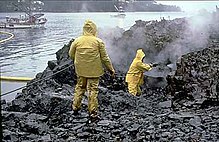
Workers using high-pressure, hot-h2o washing to clean an oiled shoreline
Chemical dispersant, a surfactant and solvent mixture, was practical to the slick by a private visitor on March 24 with a helicopter, but the helicopter missed the target area. Scientific data on its toxicity were either thin or incomplete. In addition, public acceptance of new, widespread chemical treatment was lacking. Landowners, line-fishing groups, and conservation organizations questioned the use of chemicals on hundreds of miles of shoreline when other alternatives might take been available."[3] [24] [25]
Co-ordinate to a report by David Kirby for TakePart, the main component of the Corexit formulation used during cleanup, 2-butoxyethanol, was identified every bit "one of the agents that caused liver, kidney, lung, nervous organisation, and blood disorders amidst cleanup crews in Alaska following the 1989 Exxon Valdez spill.[26]
Mechanical cleanup was started shortly subsequently using booms and skimmers, merely the skimmers were not readily available during the get-go 24 hours post-obit the spill, and thick oil and kelp tended to clog the equipment. Despite civilian insistence for a complete cleanup, just ten% of total oil was actually completely cleaned. Exxon was widely criticized for its wearisome response to cleaning up the disaster and John Devens, the mayor of Valdez, said his community felt betrayed past Exxon's inadequate response to the crisis.[27] More than xi,000 Alaska residents, along with some Exxon employees, worked throughout the region to try to restore the environment.
Though the clean-up try was diligent it failed to incorporate the majority of the oil that had spilled and that has been blamed heavily upon Exxon. On Nov 26, 1984 Ronald A. Kreizenbeck(Director, Alaska Operations Part) informed the Coast Guard that the EPA suspected, due to a contempo site-visitation during a 'Annual Marine Drill' that the Port of Valdez was not prepared to 'efficiently reply to a major spill effect'. In the letter, he stated that '[it] appears that the Vikoma boom and/or deployment vessels used may non be acceptable to handle the harsh environmental conditions of Port Valdez'[28]

Clean-up efforts after the Exxon Valdez oil spill
Considering Prince William Sound contained many rocky coves where the oil was collected, the decision was fabricated to readapt it with high-pressure hot water. However, this besides displaced and destroyed the microbial populations on the shoreline; many of these organisms (due east.g. plankton) are the basis of the coastal marine food concatenation, and others (e.g. certain bacteria and fungi) are capable of facilitating the biodegradation of oil. At the time, both scientific communication and public pressure was to clean everything, merely since then, a much greater agreement of natural and facilitated remediation processes has developed, due somewhat in part to the opportunity presented for study by the Exxon Valdez spill. Despite the all-encompassing cleanup attempts, less than ten percent of the oil was recovered.
Both long-term and short-term effects of the oil spill have been studied.[29] Immediate effects include the deaths of between 100,000 and 250,000 seabirds, at to the lowest degree two,800 ocean otters, approximately 12 river otters, 300 harbor seals, 247 bald eagles, and 22 orcas, and an unknown number of salmon and herring.[seven] [30]
Nine years later on the disaster, evidence of negative oil spill effects on marine birds was constitute in the following species: cormorants, goldeneyes, mergansers, murres and pigeon guillemots.[31] [32]
Although the book of oil has declined considerably, with oil remaining only virtually 0.14–0.28% of the original spilled volume, studies suggest that the area of oiled embankment has inverse little since 1992.[33] A study past the National Marine Fisheries Service, NOAA in Juneau, determined that by 2001 approximately xc tonnes of oil remained on beaches in Prince William Sound in the sandy soil of the contaminated shoreline, with almanac loss rates failing from 68% per year prior to 1992, to four% per year later 2001.[34] [35]
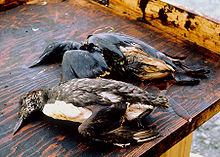
Wildlife was severely afflicted by the oil spill.
The remaining oil lasting far longer than anticipated has resulted in more long-term losses of species than had been expected. Laboratory experiments found that at levels equally depression as one role per billion, polycyclic effluvious hydrocarbons are toxic for salmon and herring eggs. Species every bit diverse as sea otters, harlequin ducks, and orcas suffered immediate and long-term losses. Oiled mussel beds and other tidal shoreline habitats may take up to 30 years to recover.[35]
ExxonMobil denied concerns over the remaining oil, stating that they predictable the remaining fraction would not cause long-term ecological impacts. Co-ordinate to the conclusions of ExxonMobil's study: "We've done 350 peer-reviewed studies of Prince William Sound, and those studies conclude that Prince William Audio has recovered, it'south good for you and it's thriving."[36]
On March 24, 2014, the twenty-fifth anniversary of the spill, NOAA scientists reported that some species seem to have recovered, with the body of water otter the latest creature to return to pre-spill numbers. Scientists who take monitored the spill expanse for the concluding 25 years report that business organization remains for one of two pods of local orca whales, with fears that 1 pod may eventually dice out.[37] Federal scientists estimate that between 16,000 and 21,000 Us gallons (61 to 79 k3) of oil remains on beaches in Prince William Sound and upwardly to 450 miles (725 km) abroad. Some of the oil does not appear to have biodegraded at all. A USGS scientist who analyses the remaining oil along the coastline states that it remains among rocks and between tide marks. "The oil mixes with seawater and forms an emulsion...Left out, the surface crusts over but the inside still has the consistency of mayonnaise – or mousse."[38] Alaska state senator Berta Gardner is urging Alaskan politicians to demand that the US government force ExxonMobil to pay the final $92 one thousand thousand (£57 million) still owed from the court settlement. The major part of the coin would be spent to stop cleaning up oiled beaches and attempting to restore the crippled herring population.[38]
As of 2012, the indirect and long-term sublethal effects of oil on shorebirds had been measured in relatively few studies.[39]
Litigation and cleanup costs [edit]

Bald eagles rescued from the oil spill
In October 1989, Exxon filed a suit confronting the Land of Alaska, challenge that the state had interfered with Exxon's attempts to clean upward the spill by refusing to corroborate the utilize of dispersant chemicals until the nighttime of the 26th. The State of Alaska disputed this claim, stating that there was a long-continuing understanding to allow the apply of dispersants to clean upwardly spills, thus Exxon did not crave permission to use them, and that, in fact, Exxon had non had enough dispersant on paw to finer handle a spill of the size created by Exxon Valdez.[xl]
Exxon filed claims in October 1990 confronting the Declension Guard, asking to exist reimbursed for cleanup costs and damages awarded to plaintiffs in whatsoever lawsuits filed by the Country of Alaska or the federal regime against Exxon. The company claimed that the Coast Baby-sit was "wholly or partially responsible" for the spill, because they had granted mariners' licenses to the crew of the Valdez, and because they had given Exxon Valdez permission to get out regular shipping lanes to avert ice. They also reiterated the merits that the Coast Guard had delayed cleanup by refusing to give permission to immediately employ chemical dispersants on the spill.[41]
Also, in 1991, Exxon fabricated a quiet, split up financial settlement of damages with a group of seafood producers known equally the Seattle Seven for the disaster's upshot on the Alaskan seafood manufacture. The agreement granted $63.75 one thousand thousand to the Seattle Seven, only stipulated that the seafood companies would have to repay almost all of any punitive damages awarded in other ceremonious proceedings. The $v billion in punitive damages was awarded later, and the Seattle Seven's share could have been as loftier as $750 million if the damages accolade had held. Other plaintiffs accept objected to this secret arrangement,[42] and when it came to calorie-free, Guess Holland ruled that Exxon should have told the jury at the start that an understanding had already been made, and so the jury would know exactly how much Exxon would have to pay.[43]
In the instance of Exxon five. Baker, an Anchorage jury awarded $287 meg for actual amercement and $5 billion for punitive damages. To protect itself in case the judgment was affirmed, Exxon obtained a $iv.8 billion credit line from J.P. Morgan & Co., who created the first modern credit default bandy so that they would non have to hold every bit much money in reserve confronting the risk of Exxon's default.[44]
Meanwhile, Exxon appealed the ruling, and the ninth U.S. Circuit Court of Appeals ordered the trial guess, Russel Holland, to reduce the punitive damages. On December 6, 2002, Kingdom of the netherlands announced that he had reduced the damages to $4 billion, which he concluded was justified past the facts of the instance and was not grossly excessive. Exxon appealed over again and the example returned to Kingdom of the netherlands to be reconsidered in calorie-free of a recent Supreme Court ruling in a similar case. Holland increased the castigating damages to $4.5 billion, plus involvement.[45]
After more appeals, in December 2006 the damages award was cut to $ii.v billion. The courtroom of appeals cited recent Supreme Court rulings relative to limits on castigating damages.[46]
Exxon appealed again. On May 23, 2007, the ninth Circuit Court of Appeals denied ExxonMobil's request for a tertiary hearing and allow stand its ruling that Exxon owed $ii.v billion in punitive damages. Exxon then appealed to the Supreme Court, which agreed to hear the case.[47] On Feb 27, 2008, the Supreme Court heard oral arguments. Justice Samuel Alito, who at the time owned between $100,000 and $250,000 in Exxon stock, recused himself from the case.[48] In a conclusion issued June 25, 2008, written by Justice David Souter, the courtroom vacated the $2.5 billion award and remanded the instance back to the lower courtroom, finding that the damages were excessive with respect to maritime mutual law. Exxon's actions were deemed "worse than negligent simply less than malicious."[49] The punitive amercement were farther reduced to an corporeality of $507.5 one thousand thousand.[50] The Court's ruling was that maritime punitive damages should not exceed the compensatory damages,[50] supported past a precedent dating from 1818.[ citation needed ] Senate Judiciary Committee Chairman Patrick J. Leahy has decried the ruling as "some other in a line of cases where this Supreme Court has misconstrued congressional intent to benefit big corporations."[51]
Exxon'due south official position was that punitive damages greater than $25 million were not justified because the spill resulted from an blow, and because Exxon spent an estimated $2 billion cleaning up the spill and a further $1 billion to settle related civil and criminal charges. Attorneys for the plaintiffs contended that Exxon diameter responsibility for the blow because the company "put a boozer in accuse of a tanker in Prince William Audio."[52] Exxon recovered a meaning portion of clean-upwardly and legal expenses through insurance claims associated with the grounding of Exxon Valdez.[53] [54]
As of December 15, 2009, Exxon had paid the entire $507.5 million in punitive amercement, including lawsuit costs, plus involvement, which were further distributed to thousands of plaintiffs.[55] This amount was ane/10th of the original punitive damages, Exxon remained hugely profitable, the procedure of payment was fatigued out over decades, and long term damage continues and is not funded by Exxon. Hence, the Exxon spill is often cited equally shorthand for corporate responsibility for societal harm not being enforced fairly.[56]
Political consequences and reforms [edit]
Coast Guard written report [edit]
A 1989 report by the Coast Guard'south U.S. National Response Middle summarized the result and fabricated many recommendations, including that neither Exxon, Alyeska Pipeline Service Company, the Land of Alaska, nor the federal government were prepared for a spill of this magnitude.[57] [58]
Oil Pollution Deed of 1990 [edit]
In response to the spill, the United States Congress passed the Oil Pollution Human action of 1990 (OPA). The legislation included a clause that prohibits any vessel that, after March 22, 1989, has caused an oil spill of more than one one thousand thousand Usa gallons (3,800 miii) in whatsoever marine area, from operating in Prince William Sound.[59]
In Apr 1998, the company argued in a legal activeness against the federal government that the send should be allowed back into Alaskan waters. Exxon claimed OPA was effectively a nib of attainder, a regulation that was unfairly directed at Exxon alone.[threescore] In 2002, the 9th Circuit Courtroom of Appeals ruled against Exxon. As of 2002, OPA had prevented eighteen ships from inbound Prince William Audio.[61]
OPA also set a schedule for the gradual stage-in of a double hull design, providing an boosted layer betwixt the oil tanks and the body of water. While a double hull would likely not have prevented the Exxon Valdez disaster, a Coast Baby-sit study estimated that it would have cut the corporeality of oil spilled by 60 percent.[62]
Exxon Valdez was towed to San Diego, arriving on July 10. Repairs began on July xxx. Approximately one,600 curt tons (one,500 t) of steel were removed and replaced. In June 1990, the tanker, renamed Exxon Mediterranean, left the harbor after $30 million of repairs.[61] In 1993, endemic past SeaRiver Maritime, it was named S/R Mediterranean, then in 2005 Mediterranean. In 2008 the vessel was acquired by a Hong Kong company that operated her equally Dong Fang Sea, and then in 2011 renamed her Oriental Nicety. In August 2012, she was beached at Dalian, China, and dismantled.[63]
Alaska regulations [edit]
In the backwash of the spill, Alaska governor Steve Cowper issued an executive order requiring two tugboats to escort every loaded tanker from Valdez out through Prince William Sound to Hinchinbrook Entrance. As the program evolved in the 1990s, one of the ii routine tugboats was replaced with a 210-pes (64 thousand) Escort Response Vehicle (ERV). Tankers at Valdez are no longer single-hulled. Congress enacted legislation requiring all tankers to be double-hulled equally of 2015.[64]
Economical and personal touch [edit]
In 1991, post-obit the collapse of the local marine population (especially clams, herring, and seals) the Chugach Alaska Corporation, an Alaska Native Corporation, filed for Affiliate 11 defalcation protection. It has since recovered.[65]
According to several studies funded past the country of Alaska, the spill had both short-term and long-term economical effects. These included the loss of recreational sports, fisheries, reduced tourism, and an estimate of what economists telephone call "beingness value", which is the value to the public of a pristine Prince William Sound.[66] [67] [68] [69]
The economy of the city of Cordova, Alaska was adversely affected after the spill damaged stocks of salmon and herring in the expanse.[70] [71] The hamlet of Chenega was transformed into an emergency base and media outlet. The local villagers had to cope with a tripling of their population from lxxx to 250. When asked how they felt almost the situation, a village councilor noted that they were also shocked and busy to exist depressed; others emphasized the homo costs of leaving children unattended while their parents worked to make clean upward.[72] Many Native Americans were worried that besides much time was spent on the fishery and not enough on the state that supports subsistence hunting.
In 2010, CNN reported on studies final that many oil spill cleanup workers involved in the Exxon Valdez response had subsequently become sick, and warned those exposed to the Deepwater Horizon oil spill to take heed. Anchorage lawyer Dennis Mestas found that this was true for half dozen,722 of xi,000 worker files he was able to inspect, despite admission to the records being controlled past Exxon. Exxon denied this in a argument to CNN:
After xx years, in that location is no evidence suggesting that either cleanup workers or the residents of the communities afflicted by the Valdez spill take had any adverse health effects as a result of the spill or its cleanup.[73]
Environmental activists and State officials became concerned that BP would use like techniques to minimize liability and de-emphasize health impacts:
the symptoms being reported in the Gulf states are the same ones that hit workers in Alaska. And only like then, people with their backs against the wall financially are flocking to the take jobs with the cleanup... I'm feeling like BP is forcing them into this situation where BP holds all the cards, and BP is letting these workers get sick
Reactions [edit]
In 1992, Exxon released a video titled Scientists and the Alaska Oil Spill for distribution to schools. Critics said the video misrepresented the clean-up procedure.[74]
In Dec 1994, the Unabomber assassinated Burson-Marsteller executive Thomas Mosser, accusing him of having "helped Exxon clean up its public paradigm afterward the Exxon Valdez incident".[75]
In popular civilisation [edit]
Several weeks after the spill, Saturday Dark Alive aired a pointed sketch featuring Kevin Nealon, Phil Hartman, and Victoria Jackson every bit cleanup workers struggling to scrub the oil off of animals and rocks on a beach in Prince William Sound.[76]
A ii-part story arc in the DC Comics title Green Arrow is inspired by the outcome.
In the 1995 film Waterworld, Exxon Valdez is the flagship of the movie'southward villain, "The Deacon," the leader of a band of scavenging raiders. In the ship is a portrait of their patron saint, Joseph Hazelwood.[77]
In the second Forrest Gump novel, Gump and Co. by Winston Groom, Gump commandeers Exxon Valdez and accidentally crashes it.[78]
Composer Jonathan Larson wrote a song called "Iron Mike" about the oil spill. The song is written in the style of a ocean shanty. It was commencement professionally recorded past George Salazar for the album The Jonathan Larson Projection.[79]
The 1992 made-for-tv set movie Expressionless Ahead: The Exxon Valdez Disaster, produced by HBO, dramatized the oil spill disaster.
On Sep 25, 1998, the fifth episode of the 4th season of Pinky and the Encephalon, "The Pinky and the Brain Reunion Special," showed a brief snippet of Brain and Pinky boarding the Exxon Valdez, thus insinuating they were the cause of the grounding.
In season two, episode eight, of Breaking Bad, entitled "Better Phone call Saul", Walter White tells Jesse Pinkman that Brandon "Badger" Mayhew is going to spill like the Exxon Valdez.[lxxx]
Run into as well [edit]
- Listing of oil spills
- Deepwater Horizon oil spill
- Ixtoc I oil spill
- Dead Ahead: The Exxon Valdez Disaster, 1992 HBO movie
- Martin County coal slurry spill
- Kingston Fossil Plant coal wing ash slurry spill
References [edit]
- ^ "Properties of Prudhoe Bay (2004) (ESTS #679)" (PDF). Environment and Climate Modify Canada. Government of Canada. 2004. Retrieved March xix, 2019.
- ^ a b c "Questions and Answers about the Spill". History of the Spill. Exxon Valdez Oil Spill Trustee Council. Retrieved May 26, 2009.
- ^ a b c Hazardous Materials Response and Assessment Division (September 1992). "Oil Spill Case Histories 1967–1991, Report No. HMRAD 92-eleven" (PDF). Seattle: National Oceanic and Atmospheric Assistants: 80. Retrieved March x, 2008.
- ^ Leahy, Stephen (March 22, 2019). "Exxon Valdez inverse the oil manufacture forever – but new threats emerge". National Geographic . Retrieved October 25, 2019.
- ^ Brandon Keim (March 24, 2009). "The Exxon Valdez Spill Is All Around United states". Wired Science . Retrieved June 29, 2010.
- ^ Shigenaka, Gary (2014). "20-5 Years Subsequently the Exxon Valdez Oil Spill: NOAA's Scientific Support, Monitoring, and Enquiry" (PDF). Office of Response and Restoration. Seattle: National Oceanic and Atmospheric Administration. Retrieved January 17, 2017.
- ^ a b Graham, Sarah (December 19, 2003). "Ecology Furnishings of Exxon Valdez Spill Still Existence Felt". Scientific American. Archived from the original on March 29, 2006. Retrieved March nine, 2008. Alt URL
- ^ "Exxon Valdez disaster – 15 years of lies". Greenpeace News. Greenpeace. March 24, 2004. Archived from the original on February fifteen, 2008. Retrieved March 10, 2008.
- ^ "16 Years Later Exxon Valdez Tragedy, Arctic Refuge, America's Coasts Still at Risk" (Press release). Sierra Club. March 23, 2005. Archived from the original on March v, 2008. Retrieved March 10, 2008.
- ^ "Valdez Marine Terminal". Alyeska Pipeline Service Visitor. 2021. Retrieved Nov 25, 2021.
- ^ "Spill, the wreck of the Exxon Valdez Implications for Safe Marine Send" (PDF). State of Alaska. p. 7.
- ^ "Exxon Valdez Photos". NOAA. p. 7. Archived from the original on July xiv, 2005.
Kickoff 3 days after the vessel grounded, a storm pushed large quantities of fresh oil onto the rocky shores of many of the beaches in the Knight Isle concatenation.
- ^ a b Practices that relate to the Exxon Valdez (PDF). Washington, DC: National Transportation and Safe Lath. September xviii, 1990. pp. ane–6. Archived from the original (PDF) on June 11, 2010.
- ^ a b "Ten years later on only who was to blame?". Greg Palast. March 21, 1999. Retrieved July 21, 2010.
- ^ a b Meyer, Bill (March 5, 2009). "Captain of Exxon Valdez offers 'heartfelt apology' for '89 oil spill in Alaska's Prince William Sound". The Plain Dealer. Cleveland, OH. Retrieved January 17, 2017.
- ^ Rempel, William C. (March 23, 1990). "Hazelwood Acquitted of 3 Charges; Guilty on 1 : Oil spill: An Anchorage jury finds the Exxon Valdez skipper culpable just on a minor pollution count". Los Angeles Times . Retrieved Dec 2, 2021.
- ^ Mathews, Jay (March 23, 1990). "Hazelwood cleared on most counts". Washington Mail . Retrieved December 2, 2021.
- ^ Palast, Greg (June 25, 2008). "Court Rewards Exxon for Valdez Oil Spill – Greg Palast".
- ^ Leveson, Nancy Chiliad. (July 2005). "Software Organization Condom" (PDF). Massachusetts Establish of Technology. pp. 18–xx. Archived from the original on November 8, 2010. Retrieved July 30, 2010.
- ^ a b Leveson, p.20
- ^ a b Leveson, p.18
- ^ Leveson, p.19
- ^ Spyrou, Andrew G. (2017). From T-2 to Supertanker: Development of the Oil Tanker, 1940–2000, Revised. iUniverse. ISBN9781462002344.
- ^ "The Exxon Valdez Oil Spill: Terminal Report, Land of Alaska Response" (PDF). Exxon Valdez Oil Spill Trustee Council. Anchorage, AK: Alaska Section of Ecology Conservation. June 1993. pp. 61–87. Retrieved March 19, 2019.
- ^ Council, Exxon Valdez Oil Spill Trustee. "Oil Spill Facts – Exxon Valdez Oil Spill Trustee Quango".
- ^ Kirby, David (April 22, 2013). "Corexit: An Oil Spill Solution Worse Than the Problem?". www.TakePart.com. Participant Media. Archived from the original on May 5, 2016. Retrieved April 19, 2016.
- ^ Baker, Mallen. "Companies in Crisis – What not to exercise when it all goes wrong". Corporate Social Responsibility News. Archived from the original on February 22, 2008. Retrieved March 9, 2008.
- ^ Resources, United states of america Congress House Committee on Interior and Insular Affairs Subcommittee on H2o, Power, and Offshore Free energy (1989). Investigation of the Exxon Valdez Oil Spill, Prince William Sound, Alaska: Oversight Hearings Before the Subcommittee on H2o, Power, and Offshore Energy Resources of the Committee on Interior and Insular Affairs, Firm of Representatives, One Hundred Outset Congress, Offset Session ... U.South. Government Press Office.
- ^ SC Jewett; TA Dean; Thousand Hoberg (2001). "Scuba Techniques Used to Appraise the Effects of the Exxon Valdez Oil Spill". In SC Jewett (ed.). Cold Water Diving for Science. Proceedings of the American University of Underwater Sciences, 21st Almanac Scientific Diving Symposium. Retrieved June 27, 2008.
- ^ "Exxon Valdez: X years on". BBC News. March 18, 1999. Retrieved May 24, 2010.
- ^ Irons, David B.; Kendall, Steven J.; Erickson, Wallace P.; McDonald, Lyman L.; Lance, Brian G. (2000). Ix Years Afterwards the Exxon Valdez Oil Spill: Effects on Marine Bird Populations in Prince William Audio, Alaska. The Condor. Vol. 102. Oxford University Press. pp. 723–737. doi:x.1093/condor/102.4.723. ISSN 0010-5422. OCLC 256945515.
- ^ Murphy, Stephen M.; Day, Robert H.; Wiens, John A.; Parker, Keith R. (May i, 1997). "Furnishings of the Exxon Valdez Oil Spill on Birds: Comparisons of Pre- and Post-Spill Surveys in Prince William Sound, Alaska". The Condor. 99 (2): 299–313. doi:10.2307/1369936. JSTOR 1369936. OCLC 4907621032.
- ^ Brusk, Jeffrey W.; et al. (2004). "Gauge of Oil Persisting on the Beaches of Prince William Sound 12 Years after the Exxon Valdez Oil Spill". Ecology Science & Applied science. 38 (1): xix–22. Bibcode:2004EnST...38...19S. doi:10.1021/es0348694. PMID 14740712.
- ^ Short, Jeffrey W.; et al. (January 19, 2007). "Slightly Weathered Exxon Valdez Oil Persists in Gulf of Alaska Embankment Sediments after 16 Years". Environmental Science & Technology. American Chemical Society. 41 (4): 1245–1250. Bibcode:2007EnST...41.1245S. doi:10.1021/es0620033. ISSN 0013-936X. PMID 17593726. S2CID 19133912.
- ^ a b Peterson, Charles H.; Rice, Stanley D.; Curt, Jeffrey W.; et al. (December nineteen, 2003). "Long-Term Ecosystem Response to the Exxon Valdez Oil Spill". Science. 302 (5653): 2082–2086. Bibcode:2003Sci...302.2082P. doi:10.1126/scientific discipline.1084282. PMID 14684812. S2CID 13007077.
- ^ "Exxon Valdez oil spill even so a threat: study". Australian Broadcasting Corporation. May 17, 2006. Retrieved March 9, 2008.
- ^ "25 years afterward, scientists still spot traces of oil from Exxon Valdez spill". PBS. March 24, 2014.
- ^ a b Walters, Joanna (March 23, 2014). "Exxon Valdez – 25 years after the Alaska oil spill, the court battle continues". Archived from the original on January 12, 2022.
- ^ Henkel, Jessica R.; Sigel, Bryan J.; Taylor, Caz G. (July ane, 2012). "Large-Scale Impacts of the Deepwater Horizon Oil Spill: Tin Local Disturbance Affect Distant Ecosystems through Migratory Shorebirds?". BioScience. 62 (7): 676–685. doi:10.1525/bio.2012.62.7.x. ISSN 0006-3568. JSTOR 10.1525/bio.2012.62.seven.x. OCLC 7791645445. S2CID 8059072.
- ^ "Exxon Sues Alaska, Charging Cleanup Delay". New York Times. Oct 25, 1989. Retrieved October 15, 2016.
- ^ "Exxon, Blaming Declension Guard, Says U.South. Is Liable in Alaska Spill". New York Times. October 2, 1990. Retrieved October xv, 2016.
- ^ Erb, George (November 3, 2000). "Exxon Valdez case nonetheless twisting through courts". Puget Audio Business organization Journal . Retrieved March 10, 2008.
- ^ Exxon 5. Bakery, CV-89-00095-HRH (9th Cir. 2006).
- ^ Lanchester, John (January 7, 2009). "Books: Outsmarted". The New Yorker . Retrieved July 21, 2010.
- ^ Liptak, Adam (Jan 29, 2004). "$4.5 Billion Award Set up For Spill of Exxon Valdez". The New York Times . Retrieved December 3, 2019.
- ^ "490 F.3d 1066". police.resource.org . Retrieved May 28, 2016.
- ^ Staff writer (October 29, 2007). "Supreme Courtroom to review Exxon Valdez laurels". CNN. Retrieved March x, 2008.
- ^ Staff writer (February 27, 2008). "High Court may lower Exxon Valdez damages". CNN. Associated Press. Archived from the original on March iii, 2008. Retrieved March 10, 2008.
- ^ Brutal, David G. (June 26, 2008). "Justices slash Exxon Valdez verdict". articles.latimes.com. Tribune Company. Retrieved June 26, 2008.
- ^ a b Exxon v. Baker , 554 U.South. (Supreme Court of the The states June 25, 2008).
- ^ "Reaction of Sen. Leahy on Supreme Court Ruling in Exxon v. Bakery". Leahy.senate.gov. June 25, 2008. Archived from the original on Jan 31, 2009. Retrieved February 25, 2009.
- ^ Egelko, Bob (January 28, 2006). "Punitive damages appealed in Valdez spill". San Francisco Relate . Retrieved March 10, 2008.
- ^ Bandurka, Andrew; Sloane, Simon (March 10, 2005). "Exxon Valdez – D. G. Syndicate 745 vs. Brandywine Reinsurance Company (UK) – Summary of the Courtroom of Entreatment Judgment". Holman Fenwick & Willan. Archived from the original on March 4, 2008. Retrieved March 10, 2008.
- ^ "Exxon Corporation 1993 Form 10-K". EDGAR. U.S. Securities and Exchange Committee. March 11, 1994. Archived from the original on March 4, 2008. Retrieved March 10, 2008.
- ^ "News and Information". Exxon Qualified Settlement Fund. Archived from the original on Baronial 26, 2013. Retrieved March 21, 2013.
December xv, 2009 [...] Exxon has now paid to the EQSF all monies owed in the EVOS litigation pursuant to the punitive damages judgment
- ^ "25 Years Afterwards Exxon Valdez Oil Spill, Visitor Still Hasn't Paid for Long-Term Environmental Damages".
- ^ The National Response Team (1989). The Exxon Valdez Oil Spill May 1989 – A Report to the President. National Service Center for Environmental Publications. Department of Transportation, Environmental Protection Agency. Retrieved April six, 2021.
- ^ McDonnell, Janet A. (1992). The U.Due south. Army Corps of Engineers response to the Exxon Valdez oil spill (PDF). Fort Belvoir, Virginia: United States Army Corps of Engineers. ISBN978-1410222534 . Retrieved Apr six, 2021.
- ^ "Oil Pollution Deed of 1990 – Summary". Federal Wildlife and Related Laws Handbook. August 18, 1990. Archived from the original on November eighteen, 2007. Retrieved March x, 2008.
- ^ Carrigan, Alison. "The bill of attainder clause: a new weapon to challenge the Oil Pollution Act of 1990". Boston College Environmental Affairs Law Review (Fall 2000). Archived from the original on April 29, 2005. Retrieved March 10, 2008.
- ^ a b "Exxon Valdez Is Barred From Alaska Audio". The New York Times. Nov 2, 2002. Retrieved March 10, 2008.
- ^ Kizzia, Tom (May thirteen, 1999). "Double-hull tankers face slow going". Anchorage Daily News. Archived from the original on February three, 2008. Retrieved March 10, 2008.
- ^ Visser, Auke. "Oriental Nicety". International Super Tankers . Retrieved June 5, 2019.
- ^ Fargo Balliett, James (2014). Oceans: Environmental Issues, Global Perspectives. Routledge. p. 51. ISBN9781317463665.
- ^ Loshbaugh, Doug (2000). "School of Hard Knocks". Juneau Empire. Archived from the original on September 27, 2007. Retrieved May eighteen, 2010.
- ^ 1994, Victor Goldberg, The Journal of Legal Studies, Recovery for Economic Loss Following the Exxon 'Valdez' Oil Spill"
- ^ Carson, Richard; Hanemann, W. Michael (December 18, 1992). "A Preliminary Economic Assay of Recreational Fishing Losses Related to the Exxon Valdez Oil Spill" (PDF). Exxon Valdez Oil Spill Trustee Council. Retrieved March 10, 2008.
- ^ "An Assessment of the Impact of the Exxon Valdez Oil Spill on the Alaska Tourism Industry" (PDF). Exxon Valdez Oil Spill Trustee Council. August 1990. Retrieved March 10, 2008.
- ^ "Economic Impacts of Spilled Oil". Publications. Exxon Valdez Oil Spill Trustee Council. Archived from the original on June 30, 2007. Retrieved March 10, 2008.
- ^ "25 Years Later Spill, Alaska Town Struggles Back From 'Dead Zone'". NPR.org . Retrieved January 21, 2017.
- ^ "Native Alaskans Still Reeling 25 Years Later Exxon-Valdez Oil Spill". www.wbur.org . Retrieved January 21, 2017.
- ^ Daley, Patrick; O'Neill, Dan (Dec i, 1991). ""Pitiful Is As well Balmy a Discussion": Press Coverage of the Exxon Valdez Oil Spill". Journal of Communication. 41 (4): 42–57. doi:ten.1111/j.1460-2466.1991.tb02330.10. ISSN 0021-9916.
- ^ "Critics call Valdez cleanup a warning for Gulf workers". CNN. Retrieved December ten, 2015.
- ^ D. Michael Fry (November 19, 1992). "How Exxon's "Video for Students" Deals in Distortions". The Textbook Alphabetic character. Archived from the original on December 10, 2014. Retrieved July 21, 2010.
- ^ Thomas, Pierre; Weiser, Benjamin (April thirteen, 1996). "Reputed 'Manifesto' Recovered". The Washington Post. p. A01. Retrieved January 28, 2011.
- ^ Nealon, Kevin (Apr 15, 1989). "Joseph Hazelwood Sketches". Sabbatum Dark Live . Retrieved June 5, 2019.
- ^ Wells, Jeffrey (August 25, 1995). "Joseph Hazelwood memorialized in Waterworld". Entertainment Weekly . Retrieved June 5, 2019.
- ^ Hiaasen, Rob (August 12, 1995). "Remaking history with Gump sequel". The Baltimore Sun . Retrieved March 31, 2018.
- ^ Gordon, David (April 4, 2019). "Hear George Salazar Sing "Iron Mike" From Jonathan Larson Project Album". Theater Mania . Retrieved April half dozen, 2019.
- ^ Breaking Bad - Saul Meets Walter , retrieved February 22, 2022
Further reading [edit]
- Lee, Douglas B. (August 1989). "Tragedy in Alaska Waters". National Geographic. Vol. 176, no. 2. pp. 260–263. ISSN 0027-9358. OCLC 643483454.
External links [edit]
- NTSB safety recommendation to address coiffure management deficiencies at Exxon and in industry
- Exxon Valdez Oil Spill Trustee Council
- ExxonMobil updates and news on Valdez
Source: https://en.wikipedia.org/wiki/Exxon_Valdez_oil_spill
Posted by: robinsonadardly84.blogspot.com
0 Response to "How Many Animals Killed For Research Exxon Valdez Oil Spill"
Post a Comment